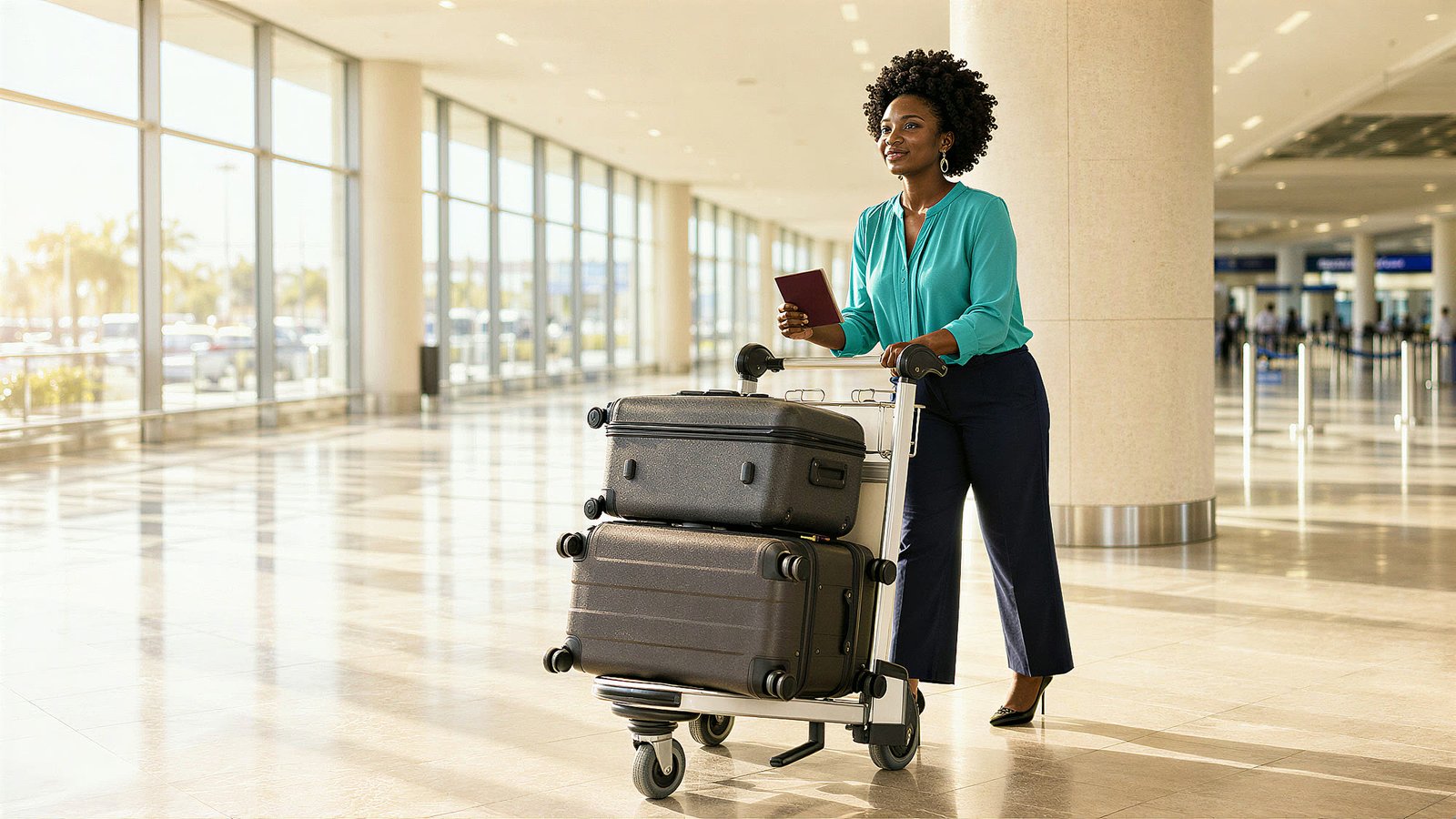
Every international Kotoka airport arrival at Accra’s Kotoka International Airport (ACC) uses Terminal 3, and you clear four checkpoints in the same order: Port Health, immigration, baggage claim and customs. Immigration ranges from 10 minutes to over an hour depending on simultaneous landings, and bags usually appear 20 to 40 minutes after landing.
The order matters because each stage checks different documents, and immigration queues depend on simultaneous landings. This guide walks the route from the plane door to the taxi rank, with sources linked along the way.
Key takeaways
- Terminal 3 handles all international arrivals; Terminal 2 is for domestic flights to Kumasi, Tamale and Takoradi.
- Have four things in your hand before the jet bridge: passport, visa or visa-on-arrival approval letter, yellow fever card, and the QR code from Ghana’s online health declaration.
- Immigration usually takes 10 minutes to over an hour, and bags appear 20 to 40 minutes after landing.
- Duty-free limits are small: 375ml of spirits, 750ml of wine and 0.5kg of tobacco in total; declare foreign currency above $1000.
- The taxi rank is outside Terminal 3 arrivals with no meters; Uber and Bolt pick up in the short-term car park and are usually cheaper.
Source: Accra Airport Guide: What to Expect at Kotoka International, November 2026
Kotoka Airport Arrival at a Glance
Every international flight at ACC arrives into Terminal 3, which GACL says opened for operations in 2018. The Accra Airport Guide reports 24 immigration counters, four e-gate positions and four 80-metre baggage carousels, plus capacity for 1,250 passengers per hour and 3,000 bags per hour.
| Checkpoint | What happens | What to have ready | Published timing |
|---|---|---|---|
| Port Health | Officer scans your health declaration QR code and checks the yellow fever card | QR code on your phone, yellow card | Not stated in the sources; keep both out |
| Immigration | Officer asks purpose of visit, accommodation and length of stay | Passport, visa, e-Visa or approval letter, return or onward ticket | 10 minutes to over an hour |
| Baggage claim | Bags come off one of four carousels one level down from immigration | Baggage receipts | 20 to 40 minutes for bags to appear |
| Customs | Green channel if you have nothing to declare, red channel if you do | Completed declaration, Bank of Ghana CDF Form 4A if carrying over $1000 | Not stated in the sources |
Times are the published ranges from the transfer guide and airport guides cited above.
Which terminal do international arrivals use?
International flights land at Terminal 3 and domestic flights use Terminal 2, with Terminal 1 also named for domestic use in some airport guides. See how this guide checks Kotoka terminal information. If you are connecting to Kumasi, Tamale or Takoradi, you leave T3 and walk or take a short shuttle to T2 — build that transfer into your plans rather than assuming you stay in the same building.
Where to check live Kotoka arrivals
For live status and delays, use the airport’s arrivals information and your airline’s app — this guide covers what happens after you land, not flight times. Screenshot your booking reference before you fly, because the free airport Wi-Fi is called KIA FREE WIFI and is free but not always reliable.
Before You Land: The Documents to Have in Your Hand
Put the documents in one folder in your carry-on, not the overhead locker. The walk from the aircraft can be long and the halls are air-conditioned, so keep them accessible for the Port Health desk. See how this guide checks Ghana visa and entry requirements.
- Passport – Ghana’s official e-Visa portal states at least six months’ validity beyond your intended stay, and U.S. passport holders applying for a Ghana visa are told to have a blank page.
- Visa, e-Visa or visa-on-arrival approval letter – an approved e-Visa is accepted at all Ghana international airports, digitally or printed, with standard processing of 96 hours.
- Yellow fever certificate – the official yellow card.
- Health declaration QR code – completed online before you board.
- Accommodation address and a phone number – written down, because the immigration officer may ask and your phone may be dead.
- Return or onward ticket – visa-on-arrival travellers must board with one, and visitors without onward documents risk refusal of entry.
The yellow fever certificate
A yellow fever vaccination certificate is mandatory for entry into Ghana. The CDC advises vaccinating at least 10 days before travel, because the certificate only counts once that period has passed, and WHO and the Ghana Health Service both describe a single dose as life-long protection. Not every clinic stocks the vaccine, so book it well ahead; children under nine months are listed as exempt by visa services, and the Ghana Health Service advises keeping the card safe because it is asked for again on departure.
Visa, visa on arrival and the Ghana Card line
ECOWAS passport holders generally travel without a visa under free-movement rules — confirm the current wording with Ghana Immigration Service before booking. Everyone else normally needs a visa or an approved e-Visa, and visa on arrival cannot be requested at the airport: it is the Emergency Entry Visa, your host or sponsor applies to GIS headquarters at No. 42 Independence Avenue, Cantonments, Accra, and the approval letter is copied to immigration at Kotoka.
The stamp is a 30-day single-entry visa, the listed fee is US$200, and processing takes 3 to 5 working days. Airlines can deny boarding without the approval letter, so carry printed copies of the letter, your passport, the yellow card and your onward ticket.
Source: Fees and Charges – GIS, Effective 15 May 2025
The arrival form: paper or online
The confirmed mandatory online form is Ghana’s health declaration, filled in at ghs.gov.gh before travel; it issues a QR code immediately and comes in English and French. The health declaration is in addition to any paper arrival card, so carry a pen.
Step 1 — Port Health: The Yellow Fever Card Check
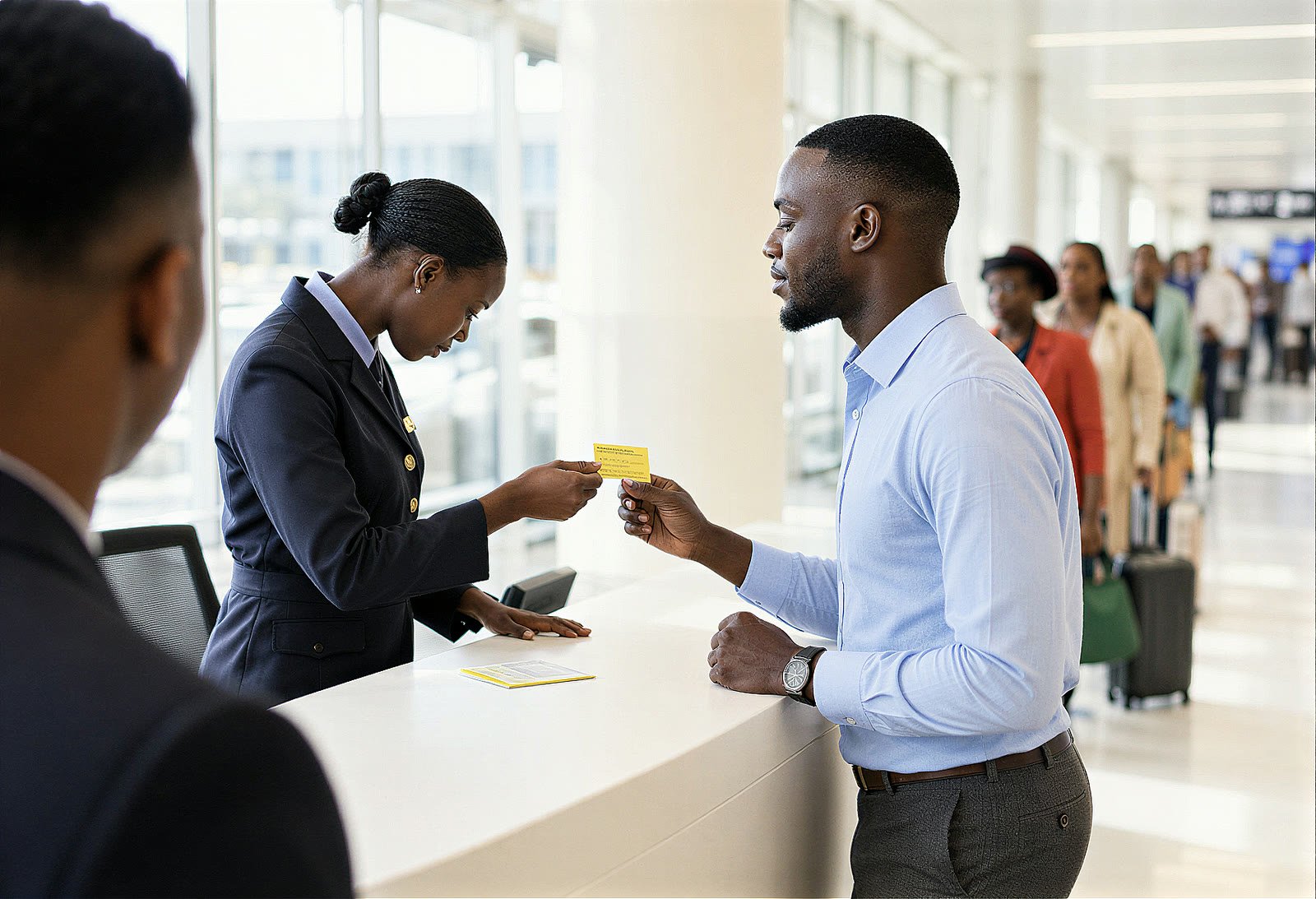
Port Health sits inside Terminal 3, and the certificate check is the first stop after the jet bridge; a 2025 first-hand Arrivals guide describes being asked for the card as soon as you step off the escalator. Each arriving passenger must also show the QR code from the online health declaration, which Port Health staff are trained to scan.
Keep the card accessible afterwards, because immigration officers may check it again before stamping your passport. Beyond that, keep the official card safe and accessible.
No certificate, no easy fix
Without a certificate you may be vaccinated on the spot or refused entry, and the officer decides. GIS lists failing to present the yellow fever card as a common arrival mistake — get the jab at least 10 days before you fly and keep the card in your hand luggage.
Step 2 — Immigration
The Accra Airport Guide lists 24 counters and four e-gate positions, and immigration queues range from 10 minutes to over an hour depending on simultaneous landings.
Which queue to join
Have your passport open at the photo page, the visa or approval letter on top, and the yellow card behind it. The officer will ask three things: purpose of visit, where you are staying, and how long you plan to stay.
Check the entry stamp is dated and legible before you walk away — it matters at exit and if you later apply for an extension. GIS also lists a US$50 e-gate fee on its schedule, but do not count on skipping the queue.
If something is wrong with your visa
Holding an e-Visa does not guarantee entry: the officer at the port of entry decides. If you are sent to a secondary desk, stay calm, produce printed copies of your approval letter, hotel booking and invitation, and answer the questions directly. Check the conditions of your visa before taking any paid work, and never describe your trip as work if you are entering as a visitor.
Step 3 — Baggage Claim at Terminal 3
Baggage claim is one level down from immigration, with four 80-metre carousels. See how this guide checks airline baggage allowances. Bags usually appear 20 to 40 minutes after landing, which is long enough to buy a SIM or change a little money first. Trolleys are free, and porters will help for a small tip in cedis — agree before they lift the bag.
Missing or damaged bags
Report the problem at your airline’s baggage assistance counter inside the baggage claim area, before you cross into customs, and ask for the report reference number and the handler’s phone number. GACL’s Lost & Found Desk in the Arrival Hall runs 24 hours a day, but checked baggage cases belong to the airline’s ground handler: Aviance on +233-544334024, Menzies on +233-266027477 or +233-307013571, and Swissport on +233-593823774 or +233-244343587.
If a bag is following on a later flight, declare it on the Passengers Unaccompanied Baggage Declaration on arrival or within 48 hours, or you can lose the concession. Keep baggage receipts until you are past customs.
Trolleys, porters and tips
Trolleys are free to use, and the route from arrivals to the taxi rank is step-free, which helps with a stroller or two heavy cases. Porters expect a small tip per bag, so agree a figure at the start.
Step 4 — Customs: The Green and Red Channels
Choose green if you have nothing to declare and red if you do. GRA expects arriving passengers to walk the most direct route to the examination area with all their baggage. Goods must be declared in writing or orally whether or not duty is due, and anything not produced for examination can be forfeited.
What you can bring in duty-free
| Item | Free allowance | Note |
|---|---|---|
| Spirits | 375ml | Per arriving passenger |
| Wine | 750ml | Per arriving passenger |
| Cigarettes, cigars, tobacco, snuff | 0.5kg in total | Combined, not 0.5kg of each |
| Electrical goods | Used by you for at least six months | Second-hand bona fide use test |
| Personal effects and tools | For your own use | Not for sale or for other people |
| Removal articles | After more than 12 continuous months abroad | Excludes vehicles and arms |
Source: GRA Passengers’ Obligations at Customs, checked November 2026. Allowances change with each budget — confirm with the Ghana Revenue Authority before you fly.
Declaring cash and high-value goods
Foreign currency above $1000 may be declared on the Bank of Ghana Currency Declaration Form, CDF Form 4A, downloadable from the Bank of Ghana site. Declaring is paperwork; not declaring is the bigger problem. Choose the red channel if you carry commercial goods, temporarily imported goods or drinks above the allowance, and keep receipts for anything expensive.
For gifts and new electronics, the concession covers goods for your own use, not for sale or for other people; anything for resale attracts duty. You can estimate the likely charge with the Ghana import duty calculator before you pack, and GRA publishes its own general goods duty calculator and tariff bands. Some links in this guide go to commercial partners, and a purchase or booking through them may earn the site a commission.
Step 5 — SIM Cards, Money and a Drink
The arrivals hall has a forex bureau, ATMs and SIM counters, plus free Wi-Fi if you only need to message home.
Which network to buy
SIM counters in the Terminal 3 arrivals hall sell Telecel and AirtelTigo starter packs, and airport guides give a starter SIM with data at roughly GHS 20 to GHS 30. Registration is mandatory, takes about 10 to 15 minutes and needs the passport you travelled on; residents register MTN SIMs with a Ghana Card at an MTN service centre. One 2025 first-hand guide says MTN needs a city office rather than an airport counter, while another source lists MTN counters in the hall — ask at the desk before you queue. Check the SIM, the data bundle and the phone work before you walk away.
Cash: bureaux, ATMs and card acceptance
The hall has a forex bureau and ATMs from Ecobank and GCB Bank, while another guide places ATMs outside the Arrivals Hall to the left, with re-entry through a different door. Airport forex rates are usually slightly worse than city rates, so change only enough for transport and a SIM. Take small cedi notes for tips and fares, and carry about US$200 as a backup in case an ATM is down or your card is refused.
Step 6 — Getting from Kotoka into Accra

The airport sits about 10 km from central Accra. The run into central Accra takes 20 to 60 minutes, and lands at the top of that band during the 07:00–09:00 and 16:00–19:00 rush hours. There is no public bus direct from the terminal, so your choice is the taxi rank, a ride-hailing app, a pre-booked transfer or a hotel shuttle.
| Option | Where it picks up | What it costs | Best for |
|---|---|---|---|
| Official airport taxi | Rank outside the Terminal 3 arrivals exit | GHS 80–120 Airport City; 100–150 Osu or Cantonments; 120–180 city centre; 150–200 East Legon or Adenta; 200–280 Tema. Cash only, 10–20% more at night | Walk-up arrivals with no booking |
| Uber or Bolt | Short-term car park or the access road | Dynamic pricing; no published airport tariff | Most arrivals, paying by card in the app |
| Pre-booked transfer | Meet-and-greet inside the arrivals hall, name board | GHS 350 flat to Osu, Airport Residential, Labadi or Accra Central; GHS 500 East Legon; GHS 700 Tema; GHS 200 extra between 22:00 and 06:00 | Late landings, families, fixed prices |
| Hotel shuttle | Arranged with the hotel before flying | Set by the hotel | Guests on hotel packages |
Taxi ranges from a Ghana transfer operator’s guide and flat fares from MyAirportPickup, both checked November 2026. Rank prices are semi-fixed and negotiable, and no airline publishes an official tariff.
Source: Airport Transfer Prices Accra & Kotoka | MyAirportPickup, November 2026
Taxi or ride-hailing: which to take
Uber and Bolt both operate at Kotoka and are consistently described as the cheapest option, with waits of 10 to 20 minutes and card payment in the app. Price your destination in the app before you approach the rank and use it as your negotiation benchmark. Taxis have no meters, so agree the total price before loading luggage, and ignore anyone inside the hall offering a taxi or to carry your bag for a fee.
Journey times and fares into Accra
Distances are short: about 3 km to Airport Residential, 6 km to East Legon, 8 km to Osu and 10 km to Accra Central. Avoid the 07:00–09:00 and 16:00–19:00 rush hours if you can, and if you are heading to Tema, expect a toll booth on the motorway that some drivers inflate. Pre-booked private transfers are also quoted in euros, from about €50 per vehicle to the city centre for two passengers.
Pre-booked car hire and airport pickup
MyAirportPickup tracks your flight, waits in the arrivals hall with a name board and includes a free waiting window of 30 minutes, so a delayed landing does not cost you the car. That is worth paying for at 01:00, with children, or when you do not want to negotiate in cedis after a long flight.
Pre-book an airport pickup or a car with a driver
Jaano lists chauffeured vehicles for airport runs, including a Mercedes V-Class with driver from GH₵900 per day, alongside self-drive rentals. Check current pickup pricing, waiting time and booking lead time when you enquire.
First-Timer’s Arrival Checklist and How Long It Really Takes
Work through this list before you leave home, and the arrival becomes a routine walk rather than a series of decisions.
- Passport with six months’ validity and a blank page Check
- Visa, e-Visa or visa-on-arrival approval letter, printed Check
- Yellow fever certificate in your hand luggage Check
- Health declaration QR code saved offline Check
- Pen for the arrival card Check
- Accommodation address and phone number written down Check
- Return or onward ticket Check
- About US$200 cash and a card that works abroad Check
- ESIM installed or roaming activated Check
- Transfer booked or ride-hailing app installed Check
The realistic timeline runs from wheels-down to hotel door in stages, and the spread is wide: immigration alone ranges from 10 minutes to over an hour, and the drive into town from 20 to 60 minutes depending on traffic.
Common arrival mistakes
The four that cost the most time
Joining the wrong immigration lane, leaving the yellow card in a checked bag, crossing into customs before reporting a missing bag, and walking to the far end of the airport looking for an app pickup. Fix all four by reading your documents at the gate and requesting the ride while you are still inside the terminal.
If your flight lands late at night
Many international flights land at Kotoka between 22:00 and 02:00, including routes from London, Amsterdam, Dubai and Istanbul, and Terminal 3 stays open and staffed. Taxis run around the clock but charge 10 to 20% more at night, and surge pricing hits hardest in that window — which is exactly when a fixed-price pickup earns its keep. If your flight is delayed, a pre-booked operator tracking the flight adjusts the pickup without you calling.
Check with the airline, Ghana Immigration Service and Ghana Revenue Authority before you fly, since allowances, visa rules and terminal arrangements change. For wider context on routes and tickets, see airline tickets to Ghana.
Next step: if you would rather not haggle for a taxi at midnight with two suitcases, arrange an airport pickup or a car with a driver before you fly, and land with the transfer already paid and the driver holding your name. Some links in this guide go to commercial partners, and a purchase or booking through them may earn the site a commission.
Sources
- Ghana Airports Company Limited (GACL) — terminal information and passenger services
- GACL Passengers Guide — Lost & Found desk, ground handler contacts, Port Health location, free Wi-Fi
- Accra Airport (ACC) arrivals and terminal information
- Ghana Immigration Service — visa on arrival, fees and charges
- Ghana eVisa official portal — passport validity, e-Visa acceptance and processing
- Ghana Revenue Authority — Passengers’ Obligations at Customs
- Ghana Revenue Authority — Customs Tariffs and Levies
- Ghana Health Service — online health declaration and yellow fever card
- WHO — Yellow fever
- CDC — Yellow Fever in Burkina Faso, Côte d’Ivoire and Ghana
- Accra Airport Transfer Guide — Getting to the City
- Accra Airport Guide: What to Expect at Kotoka International
- Accra Airport Transfer Guide, Chris Mobility Africa
- MyAirportPickup — Airport Transfer Prices Accra & Kotoka
- Uber Ghana
- MTN Ghana
- Jaano — car hire in Ghana
- DutyCalc — Ghana import duty estimator
- FCDO travel advice: Ghana
This guide follows the editorial policy on how airport and immigration rules are checked.
Frequently asked questions
Which terminal do international flights arrive at in Accra?
International arrivals use Terminal 3 at Kotoka International Airport. Domestic flights to Kumasi, Tamale and Takoradi use Terminal 2, a short walk or shuttle from T3.
How long does it take to get through Kotoka airport arrivals?
Immigration takes 10 minutes to over an hour depending on how many flights land together, bags usually appear 20 to 40 minutes after landing, and the drive into Accra takes 20 to 60 minutes.
Do I need a yellow fever certificate to enter Ghana?
Yes. A yellow fever vaccination certificate is mandatory, the jab should be at least 10 days before travel, and a single dose is treated as life-long protection. The card is checked at Port Health in Terminal 3 and may be asked for again at immigration and on departure.
Can I get a visa on arrival at Kotoka International Airport?
Not by asking at the desk. Visa on arrival, the Emergency Entry Visa, needs prior approval from the Ghana Immigration Service, arranged by your host in Ghana, costs US$200 on the GIS schedule, takes 3 to 5 working days and gives a 30-day single-entry stamp. Airlines can refuse boarding without the approval letter.
How much is a taxi from Kotoka airport to Accra, and is Uber available?
Rank taxis quote roughly GHS 100–150 to Osu or Cantonments, GHS 120–180 to the city centre and GHS 150–200 to East Legon, cash only and 10–20% more at night. Uber and Bolt both operate from the short-term car park and are usually the cheaper option with dynamic pricing in the app.